Should You Paint Your Window Frames Black? The Honest Answer
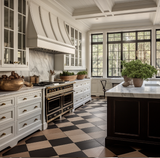
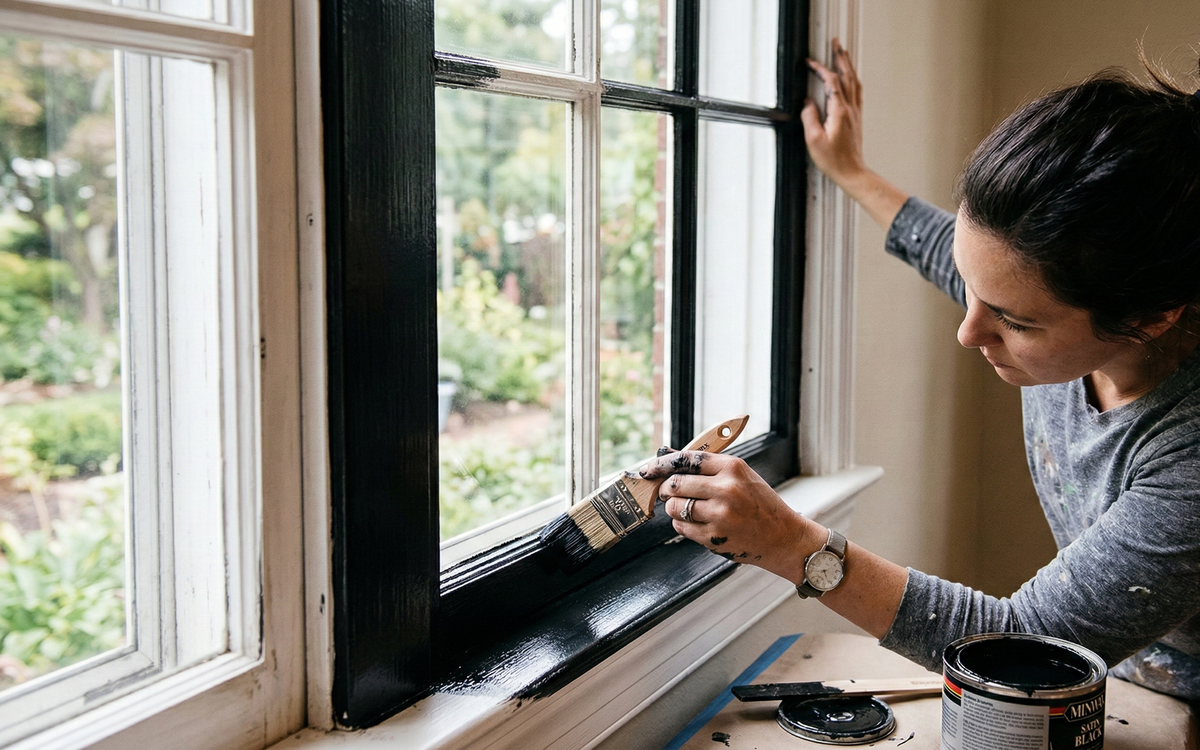
Can you just paint the ones you have instead of replacing them?
Sometimes yes. But there are a few things worth knowing before you commit three weekends and a quart of Benjamin Moore to this.
Where I'm coming from: I've painted window frames more times than I can count. I've done black once — large sliding wood doors opening onto a yard — and it worked. But I haven't done it in every space I've worked on, because most rooms I've been in haven't been right for it. What follows is firsthand process knowledge, honest research on the color-specific stuff, and a clear framework for deciding if your space is actually ready.
The One Time I Did It — And Why It Worked
Large sliding wood doors. Minimal frames. Strong view of a yard.

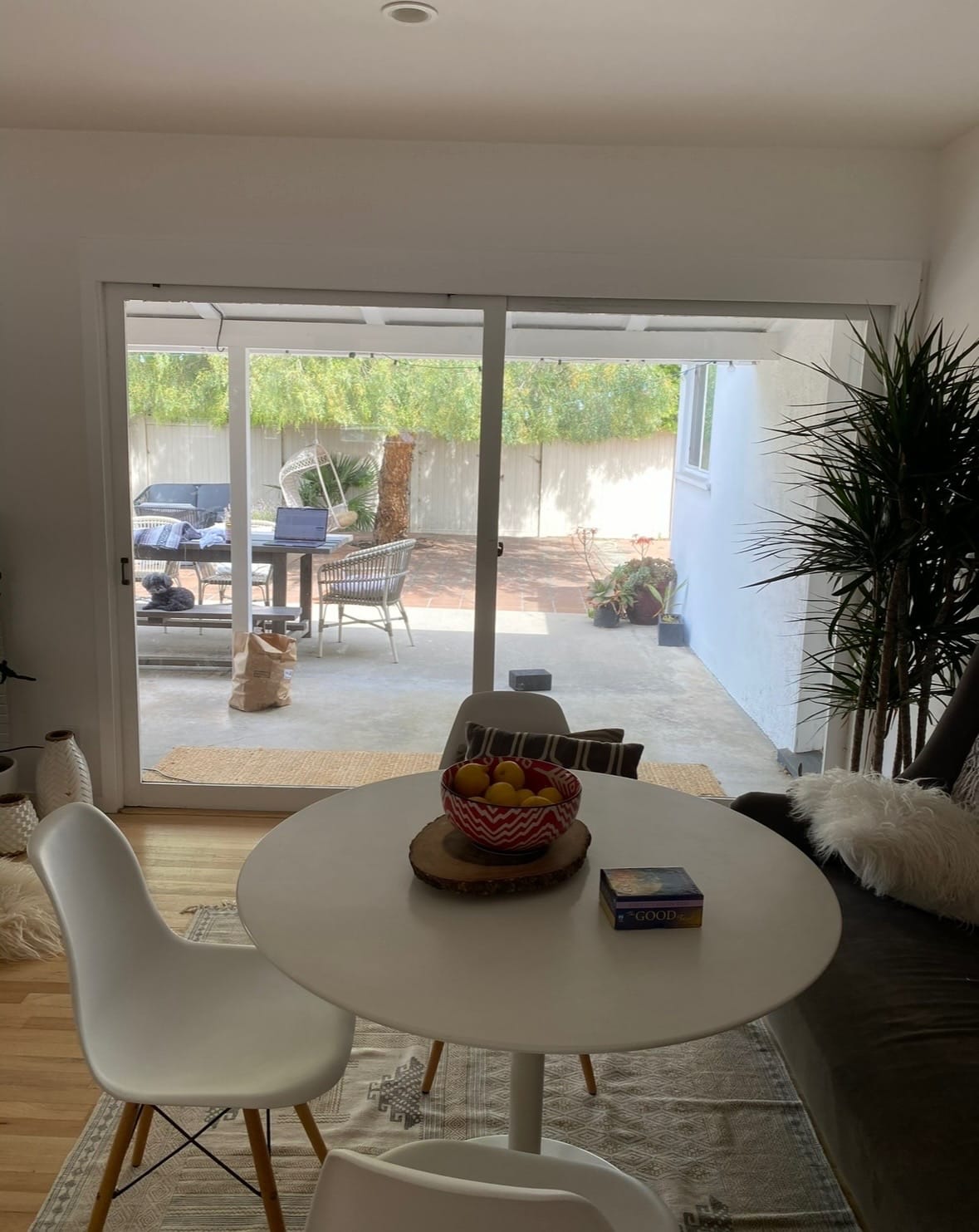
Don't judge the design choices in these photos — it was 2020. We were all doing things.
The black didn't create a heavy border — it disappeared and let the view become the focal point. Your eye went straight through, not to the frame.
That's the distinction. Black frames done right don't announce themselves. When they feel heavy or forced, it's usually because the frames are too thick, the room too dark, or the view not strong enough to carry the contrast.
Before you commit: is there something worth framing here? Or are you trying to manufacture a look your space isn't set up to support?
Why I Haven't Done It Everywhere
Most rooms I've worked in haven't earned it.
Black frames need good natural light, a view worth framing, and a palette that can absorb the contrast. In a smaller or darker room they don't read as dramatic — they read as heavy. Forced. Like you were chasing a look rather than solving for your space.
If your room has the light and scale for it: legitimate project. If you're doing it because it looks good on Pinterest without checking your actual room: that's where design regret starts.
The Part Nobody Wants to Hear: Prep Is Everything
I've paid the price of not being honest with myself about this. Prep is the entire project. The painting is the easy part.
I am not a patient person. And I have repainted window frames I didn't prep properly — which costs significantly more time than doing it right once. Black is unforgiving. Every imperfection white would hide, black displays.
What proper prep means: clean thoroughly, sand any glossy existing finish, prime before you paint. Skip any of these and the result will show it.
Also — check condition before you start. Black paint over weathered or peeling frames isn't a fix. It's a more expensive problem.
The Pane Problem
Three options, all of which I've encountered:
Taping. Tedious, and you still end up with cleanup after. The tape moves the problem, it doesn't eliminate it.
Paint over and scrape. My preferred method. Paint slightly onto the glass, let it dry fully, scrape the excess with a razor blade. Faster than taping, cleanup is clean and controlled. The word that matters is dry — scraping too early makes a mess.
Liquid masking film. What professionals use when spraying large spaces. Overkill for a brush paint job on a few windows.
All three involve cleanup. Factor that in regardless of which you choose.
On Brush Painting
Slower, more controlled, cheaper to set up. What I'd recommend for most people doing this as a DIY.
Two things learned the hard way: use less paint per stroke than feels necessary — drips on vertical surfaces are the enemy — and be genuinely patient between coats. Not "looks dry" patient. Cure-time patient. Applying the next coat too early pulls up what's underneath. This is where my immediate gratification tendencies have cost me time more than once.
The Decision Framework
Frame condition: Solid and stable? Good candidate. Weathered or peeling? Fix that first.
Light and view: Bright room, strong view? Yes. Dark room, nothing compelling outside? Reconsider.
Frame size: Minimal frames carry black well. Thick frames in a small room will feel heavy.
Prep honesty: Will you actually clean, sand, prime, and take your time between coats? If yes — good result. If no — save yourself the redo.
What to Use
Trim paint, semi-gloss or satin. Benjamin Moore Advance and Sherwin-Williams Emerald Urethane are the standard recommendations for a reason — both level well and cure hard.
For color: Iron Ore, Tricorn Black, and Black Beauty read differently depending on your light. Sample in your actual room before committing to all twelve windows.
Bonding primer. Non-negotiable.
The Bottom Line
Black frames done right don't look like a design decision. They look like the room was always supposed to be that way.
If the conditions are right, the frames are in good shape, and you're willing to do the prep: this project is worth doing. The cost savings over replacement are real. The result is achievable.
The only thing standing between a good result and a bad one is patience — with the space assessment, the prep, and the drying time. Which, if you're anything like me, is exactly the part that's hardest to give.
Not sure if black frames are right for your space? Start here first: Black Framed Windows: A Timeless Choice or Just a Passing Trend?